Blog,
Why we built channelos.tv
A software firm should run something of its own. channelos.tv has the hard parts most client systems have, in one product, and we run it in production.
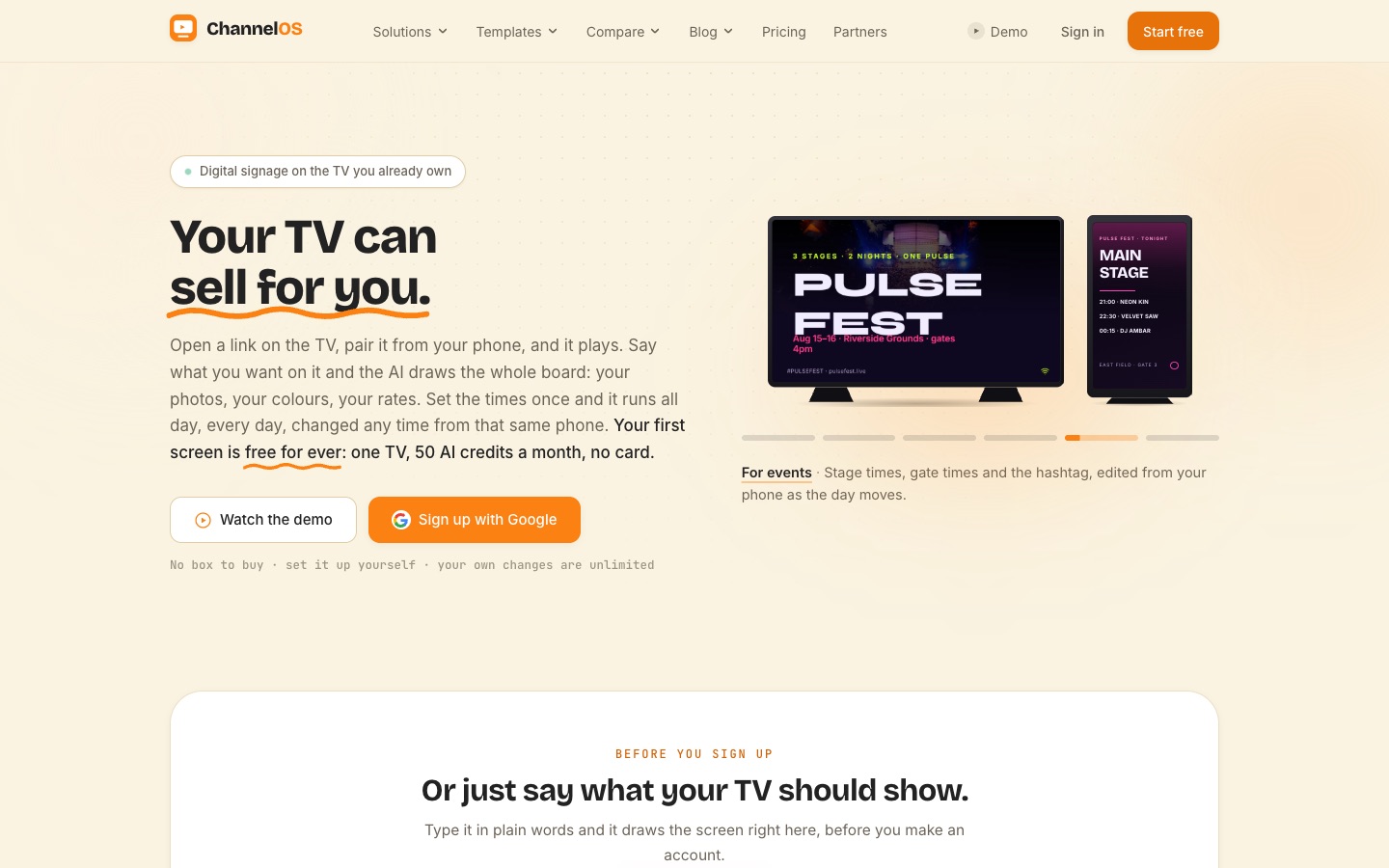
channelos.tv turns a TV you already own into a digital sign. An owner signs in, designs a screen or lets AI draft it, and the TV updates on its own. It has been in production since June 2026.
Here is why a software and AI firm built a product of its own, and what it shows a buyer before the first call.
A firm that builds for others should run something of its own
Anyone can list technologies on a services page. A buyer cannot open that list and check it. They can open a product.
channelos.tv is that product. It was designed and built in-house, front end and back end, and we run it in production. That is the same arc we take on for clients: plan it, build it, ship it, then keep it running.
It has the hard parts, all at once
Most client systems have a few of these. channelos.tv has all of them in one codebase:
- Sign-in and workspaces with roles. Different people in one business see and change different things.
- Metered AI usage. Every AI draft has a cost, so usage is metered.
- Subscriptions. Plans and billing.
- Live sync to devices nobody can walk up to. A TV on a wall has no keyboard and nobody standing by to restart it, so the system has to keep every screen in step on its own.
Getting each of these right on its own is ordinary work. Keeping them right together, in production, is the part a buyer is paying for.
How it is built
- Operator app and TV player. React 19 and Vite. The operator designs screens in the browser, and a separate player runs on the TV.
- API at the edge. Hono on Cloudflare Workers, with D1 and Drizzle for data and R2 for media.
- Live sync per screen. A Durable Object holds a Yjs document for each screen, so an edit reaches the TV without a refresh.
- AI generation. A Python service on LangGraph and FastAPI drafts layouts. It has unit tests and a pass or fail gate over saved output.
- Kiosk client. A Kotlin app for Android TV that boots straight into the player.
What we count
On 23 September 2026, the codebase and production database held:
- 414 API route handlers
- 217 React components
- 36 database tables
- 2,006 end-to-end tests
These are counts, not results. They show how much there is to keep working.
What this means for a client project
The same practices and stack go into the work we do for clients:
- Custom software development for products with this many moving parts.
- AI agent development, with AI output tested before it is trusted.
- A production readiness review for systems that are live but not yet safe to grow.
Open channelos.tv to see the product, or read the case study for more detail.